Although its origin is uncertain, it is assumed that comets were born in China for over 2,500 years. There are several legends about its origin: a bamboo hat of a peasant carried by the wind, the sail of a ship or perhaps the work of the philosopher Mo Ti, built a bird-shaped kite that was flying three days as birds.
The truth is that kite flying was a meditation practice for the Chinese. But besides these recreational or religious purposes, kites were used, as well as they would in Polynesia years later, such as fishing gear, tying a hook with a bait to a comet then let go from a boat, taking care to position the device at a sufficient distance from the shadow cast by the boat, to lure fish .
The Chinese also found military applications for this purpose, they could be from a signaller in the field, measure the distance to a besieged camp, and even, in some accounts it is said that there were men who flew these objects on besieged cities.
Kite extending from China throughout its area of \u200b\u200binfluence and appears in Southwest Asian countries like Korea, the archipelago Malaysia, Indonesia and Burma, as well as Japan and India. It is unknown when this expansion took place, but it is likely to take place in a short space of time, because the comet is soon to be released by the Polynesian, becoming known in places as far east as Easter Island. Similarly, through India, extending west to the Arabian peninsula and North Africa.
In Europe, the comet was known before the sixteenth century in three ways: the Mongol invasions, trade routes via the Cape of Good Hope and contacts with the Arab world. European history of the kite begins to tell tales called Dracos or dragon-shaped which were used as standards in the last days of the Roman Empire. These objects consisted of a wide-mouthed cylindrical bag that looked like a dragon or other animal that is fantastic and had tied at the top of a mast. By swell filled air, waving to the wind on the riders in battle. Its purpose was to cause terror to the enemy in battle and act as a pendant or pennant that allowed archers to know the wind direction.
Already in the fourteenth century see a detailed description of a dragon-shaped kite in various documents of the time, as the treaty of military technology Bellefortis (1405) Kieser Conrad or a manuscript of 1430 preserved in Vienna. But in the late seventeenth century when the kite is extremely popular throughout Europe, even if limited to the realm of children, as a hobby or fireworks. Their scientific potential was not recognized until well into the eighteenth century, except for some non-documented experiments did Isaac Newton, concerning the geometric aspects of the shapes of comets. Another of the scientists who experimented with kites was Benjamin Franklin who, one stormy day in June of 1752, was conducting trials with electricity. When raised to heaven his famous "electric comet" with a key tied to the rope, found to be produced electric shock, which allowed him to demonstrate the nature of lightning and subsequently invented the lightning rod.
Despite these precedents, kites are not regularly used to raise instruments meteorological observations until the nineteenth century. From this period dates the invention of William A. Eddy (1891) and L. Hargrave (1894), which accounted for a revolution in their use in the study of the atmosphere. The first manufactured a conventional kite with the bar arched to form a dihedral angle, allowing him to fly without a tail, the comet's second was a three-dimensional structure consisting of two interconnected boxes with open ends.
late nineteenth and early twentieth centuries, coinciding with the development of aviation systems were invented to raise for military observers on the battlefield. These trains consisted of large kites to them a basket hanging from the kite or your thread to hold the viewer. Had more or less success, but in the end were more effective balloons. The most likely system was adopted even by the Navy and British Army, was the one who used the kite designed by aviation pioneer Samuel Franklin Cody (1903), which consisted of two double cells Hargrave attached to each other and provided angular wing. The first
decade of the twentieth century, Alexander Graham Bell experimented with kites to build a flying machine that could be manned. Built huge comets formed by a large number of tetrahedral cells. In 1907 he built a of 3,393 cells, drawn with a steamer, rose 50 meters above ground level. Other construction tetrahedral larger engine powered, did not give the desired result, so in 1909, chose to pursue other activities.
After the Second World War, the American engineer Francis Rogallo developed a comet that pioneered the new form known as semi-flexible, because it acquired as characterized by the combination of wind and a six flanges. NASA was interested in the idea of \u200b\u200bRogallo, who thought to use as a parachute in the reentry of space capsules. The current delta-wing gliders and kites two threads are two implications of this research.
In 1963, the American Domina C. Jalbert was inspired by the wing of his plane for the design of a flexible kite (parafoil) that had all the advantages of the aerodynamic principles of rigid wings because the comet did not need any rod, and getting their shape and stiffness of flight through internal sacs swelled with the wind, which gave way alar high stability and high lift.
Today kites appearance of two, three and four-wire and traction kites have the same popularity as a sport and entertainment.
classes of comets
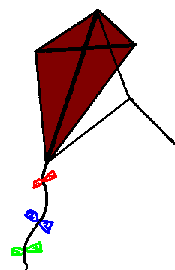
- Kites kite string or static: those remain stable in the air around an equilibrium position. Need a single thread for its control.
- sports Comets (acrobatic drives): that pose more than one thread - two, three and four-through which can be directed to the kite in flight.
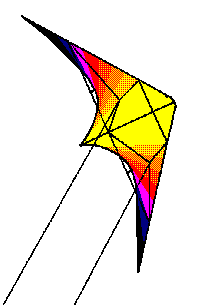
Two Threads: His way of flying is simple, when you pull one thread, the comet was deflected to the side that has been pulled. To regain your balance, pull the thread otherwise.
This form of management is common to all comets with two wires.
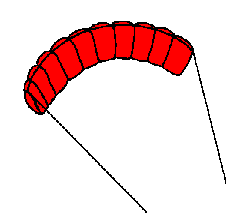
Three Wire: To handle this kite uses a triangular-shaped knob or "Y", and can be controlled with one hand.
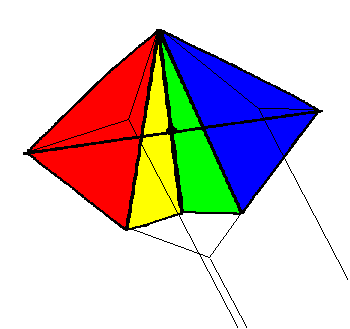

Four Wire: Apart from a model invented in 1822, the four-wire comets are relatively recent. Including two types fundamental
Revolution and similar model: The Revolution is the most popular kites four wires. It consists of a horizontal rod, which suspended two triangular sails. A pair of wires are attached to each triangle, one down and the other half of the rod that passes through them. Each pair of wires is controlled by a knob, turning the same is achieved by varying the angle of each triangle, making the kite turn left and right and even be suspended motionless in the air.

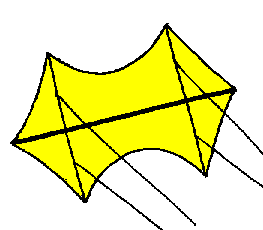
Parafoil of four threads or Quadrifoil: The Quadrifoil are similar to the "Flexfoil" with the difference that a group of flanges are tied at the back of the sail. These flanges are joined into four groups, which are controlled by two knobs, like other comets four wires.
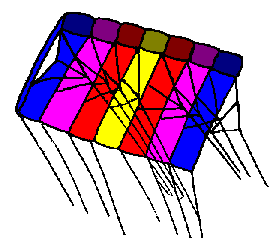
response to kites as a single thread can be classified into:
- Planas: formed by a flat-coated frame sailing, you need a tail for stabilization.
Diamond: This is the popularly recognized that the comets, we can determine their origin extremely oriente.Fue introduced by traders in Europe through the Silk Road.
In 1634 described in the book The Mystery of Nature and Art by English author John Bate as a means of entertainment, spooling firecrackers and fireworks.

Pera Punta English or arched: Originally from the island of Java became popular in Europe thanks Portuguese traders. It became very popular in nineteenth century England.
In 1826 the English inventor George Pocock used a train of two such as a method of traction kites to pull carriages and boats.

Rectangular or Della Porta: In 1589, the book of the Italian Giambattista della Porta entitled Magiae Naturalis, describes a type of flat kite with a triple flange, inspired Chinese designs, describes the use to lift fireworks, for it's decorated with a dragon.
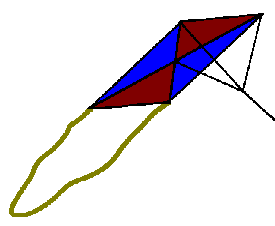
Yakko, Sode and Kimono: is a Japanese original design. How to engage the flange deforms the structure giving it stability.

Barn Door: Comet used in the nineteenth century scientist Alexander McAidie to lift meteorological instruments at the Blue Hill Observatory, near Harvard (USA).
Its form part of a square kite della Porta, which has added a third rod.

Hexagonal and Shapes: The hexagonal shape, together with the diamond, the more popular.Una good tail provides excellent stability. It is the traditional form of MILOTXA Valencia and kites are flown in Bermuda.
of Eastern origin, are the basis of countless shapes (polyhedrons and stars).
In Guatemala, the feast of All Saints is flying a large kite multipoliédrica (twelve to fourteen sides) nearly circular, to remember the spirits of the dead.

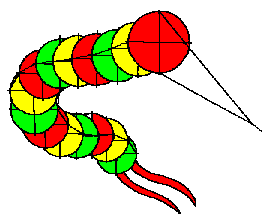
Snakes and Centipedes or Chinese Dragon: Snake The comet originally from Thailand and Cambodia, is formed by a head, a flat kite-shaped arch with a huge tail of great length reminiscent of those reptiles. In the fifteenth century is described by Kyes Conrad in his treatise on military technology Bellifortis (1405) as a banner or flag. A more detailed description is in a manuscript of the year 1430 which is preserved in Vienna, detailing how to build the framework of the head and the cloth to use as a candle. The flange of this type of kite is as della Porta.
animal forms have fascinated kite builders worldwide. A variant of these forms is the centipede or Chinese dragon, which is nothing but a long train of decreasing size circular kites attached to each other.

Delta: The delta kite, named for its resemblance to the fourth letter of the Greek alphabet comes from experiments carried out in the fifties by the American engineer Francis Rogallo to develop a parachute to slow the space capsule re-entering the atmosphere. Fruit of them are current ALA DELTA planners. This kite is highly stable due to its keel, which makes maintaining a leisurely flight in light winds.

- Curved or dihedral angle: originating from the island of Java, are characterized having no tail. Its stability is achieved by the way that occurs when bending the horizontal crossbar.
Eddy Kite (Malay): The century XIX W. Eddy redesigned this type of kite to use as a kite weather, in order to avoid the entanglements that occurred on trains kites with tails.

Reproduction of the original patent Eddy Kite (1900)

Rokkaku and "Levitor" Baden-Powell: The Sanjo-Rokkaku kite is curved traditional Japan. Used as a kite fighter, built with bamboo and silk lavishly decorated, and the team flies to the battle is to break down the kites of the other teams.
Based on this curved hexagonal shape in the nineteenth century BFS Baden-Powell, brother of the founder of the Boy Scouts, designed a kite called "Levitor." A "Levitor" of 11 m. high, flying in the train of four to six of them depending on the wind, could raise a person for use in artillery observation. The "Levitor" Rokkaku differs from the longitudinal rods that are not curved, but they themselves are bent under the wind.

Fighter Kites: Kite combat India (first) and Japan's Nagasaki Hata (second), are unstable and comets on the fly when they are released tend to rotate around the axis of the wire. By stretching the wire, due to the provision of flanges bulge for stabilizing the wind and the direction toward which the apex points and maneuvers wire pull / unscrew / pull your flight is controlled to to drop or knock the opponent's kite. These kites are constructed of bamboo and tissue paper or similar.
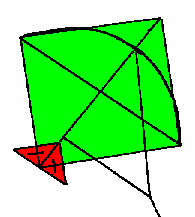
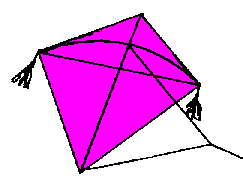
dihedral Comet Roller: The dihedral Comet Roller is highly stable due to its shape keel. This kite was designed by Alick Pearson kite builder nineteenth-century English.
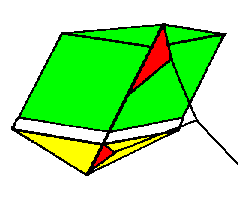
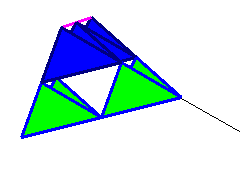
Comet Tetrahedron: The tetrahedral kite can be classified among the cell or dihedral. It is composed of multiple cells with tetrahedral coated on both sides.
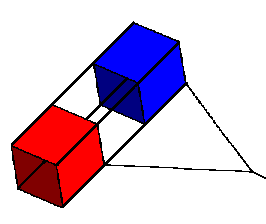
- Kites box or cell: dimensional structures consisting several interconnected boxes with open ends.
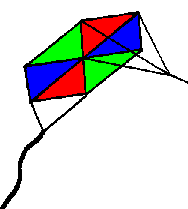
box kites or Hargrave: In 1893 Lawrence Hargrave in Australia invented the box kite, or cellular, large carrying capacity and stability is due to its structure formed by two pairs of rectangular planes placed perpendicularly. Be the basis for design of most of the comets that would be used in meteorological observations in systems to lift people and base the development of the primitive aircraft in the late nineteenth and early twentieth centuries.

original map Hargrave kite

Based on the original design of the kite Hargrave has multiple changes, especially with the addition of wings and new geometries, born other comets sometimes referred to as a compound.

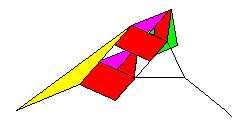
Cody Kite: late nineteenth and early twentieth centuries, coinciding with the development of aviation systems were designed for use by the military to raise observers in the field, as discussed in the comet Levitor. " These systems consist of large comets trains were more or less success, but ultimately more effective were the Globes and this coupled with the immediate appearance of the aircraft (Whight brothers' flight in 1903) left them in abeyance.
The system most likely had even adopted the English Navy and Army was employing a kite invented by Samuel Franklin Cody. This is seen in the figure and consists of two double cells attached Hargrave, angular wings fitted. The building is original that only takes two diagonal rods to tighten the joint.

Conyne Comet: Conyne Kite, also called "French military kite, as it was used by the French Army as a system to elevate observers, is a triangular box kite which have been added wings, was patented in 1902 by the American Conyne Silas.

A modification of the Conyne is to add the wings in the style of Delta, thereby achieving a more stable flight.
Other cellular models
composed of Peter Lynn Kite
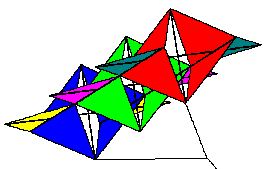
Comets star-shaped cell


meteorite or comet snowflake

CircoFLEX: is so far the latest development in the world of cellular kites, because the Dutch Helmut Schieffer and Tom Oostveen, who presented it at the Festival of Dieppe in 1996. It consists of a tape or edge ring that has a flexible rod, which together with a series of strategically placed brackets in flight becomes circular.

- semiflexible: comets with or without rods, with a flexible sail, to take shape by the wind.
Rogallo Comet: After World War II Francis Rogallo American engineer, developed a type Comet who pioneered a new type of form, known as rigid. The characteristic of this comet is that is shaped by the combination of wind and a six bridas.Con thereby achieving a stable wing and a great glide ratio. NASA was interested in the idea of \u200b\u200bRogallo, to be used as a parachute re-entry of space capsules. The result of these investigations are the Delta Wing Glider and how to stunt kites with two wires.

Reproduction of the original patent Rogallo Kite (1951)

Sled Kite: The kite sled or SLED was developed by William M. Allison in 1950, consists of two rails, a flexible sail and two flanges, getting his way by the wind. In recent years there have appeared a number of variations of the sled kite, which rails have been replaced by two tubes, the air puff give rigidity to the form that allows you to fly. These kites with no rigid parts can be folded and fit in your pocket, as compensation need more wind to fly, they must inflate the tubes.
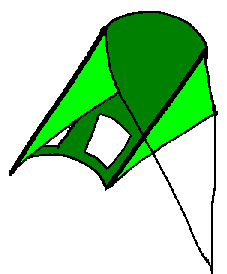

- parafoils: comets such needs no rod, shape and rigidity are achieved by flying through internal sacs swell in the wind, which allows a very stable wing shape and a large lift force

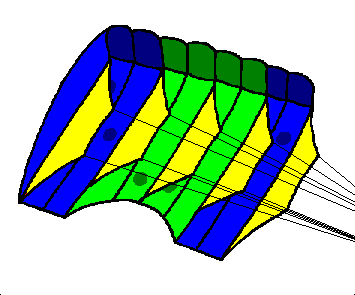

- Rotor: comets are basically a free gyro motor. Its working principle is based on a rotating body immersed in a stream of air, besides being dragged through the same experiences a vertical lift upward.


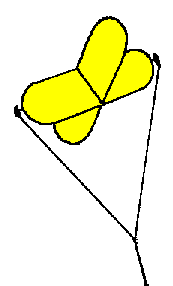
sport kites according to their structure can be framed and flexible type.
Applications of the kite
kites and gear
From China to the islands of Polynesia, the kite has been used for fishing. Made from plant leaves, is flying at a considerable height from the sea shore or a canoe. In the bottom of the kite hangs by a thread other than the flight controls, leading down to the water's surface, at whose end is attached to the hook.
Comets Lifeboat
One of the many applications of the comet during the nineteenth century was the sea rescue. Since most of the wrecks occurred near the shore, it was feasible to use a kite to build a boat out from shore and thus rescue the castaways.
weather Comets
Also in the nineteenth century regularly used kites to lift instruments meteorological observations. Using individual comets form trains of up to eight comets was reached heights up to 9740 meters. The appearance of the first aircraft and improving the balloons caused the comet to enter into disuse. Were no longer used in the early thirties of the twentieth century.
kite aerial photography
Before the advent of airships and airplanes were used kites for aerial photography. The system was as simple as hanging on a kite string or on a camera, a remote mechanism that triggered the camera while in the air.
Comets and radio
On 12 December 1901, Guglielmo Marconi used a kite to lift an antenna at a height of 122 meters in the first transatlantic radio transmission from Poldhu (England) St. John's, Newfoundland. During World War II used a rectangular box-type kite as equipping aircraft lifeboats. This was used to build a cable that was used as an antenna for a radio distress.
military Comets
Kites have been used for military purposes since ancient times in China and Japan. The strategists found a valuable auxiliary kite, which took in the transmission of clock signals to measure distances and, of course, for the elevation of human observers, in direct competition with the balloons at the end of XIX. Military ballooning services in some countries disposed of comets in their equipment, since they are easier to transport and, under certain weather conditions are more stable than balloons. While these systems obsolete plane left in 1943, during World War II, German submarines without an engine employing a gyro for observation, the observer sat in the machine and flew to be towed by the submarine, rising on the sea surface, "to which the Germans called Focke Achgelis FA330. In this war, kites were also used as targets in shooting practice as anti-air barriers.
Other uses
Other applications of the kites are for advertising, posters and advertisements to raise, as part of pulling carts and boats, to transport cables -guidelines for the construction of bridges, testing element of the first airplanes, etc.

